

Mobility is a requirement of the Erasmus Mundus Joint Masters. All EMJM include compulsory physical mobility for all enrolled students (EMJM scholarship-holders or not), consisting of a minimum of 2 study periods (1 study period = 30 ECTS) in 2 countries, which must be different from the country of residence of the student at enrolment stage.
Mandatory mobility is a fundamental aspect of the EMJM Bioceb
Mobility was conceived as essential for the students’ experience within the programme, as both an opportunity to fully encompass the richness of Bioceb scope, providing thus the best possible training through combinations of competences, and to develop additional adaptability and flexibility skills, giving the students the keys to face the challenges of tomorrow.
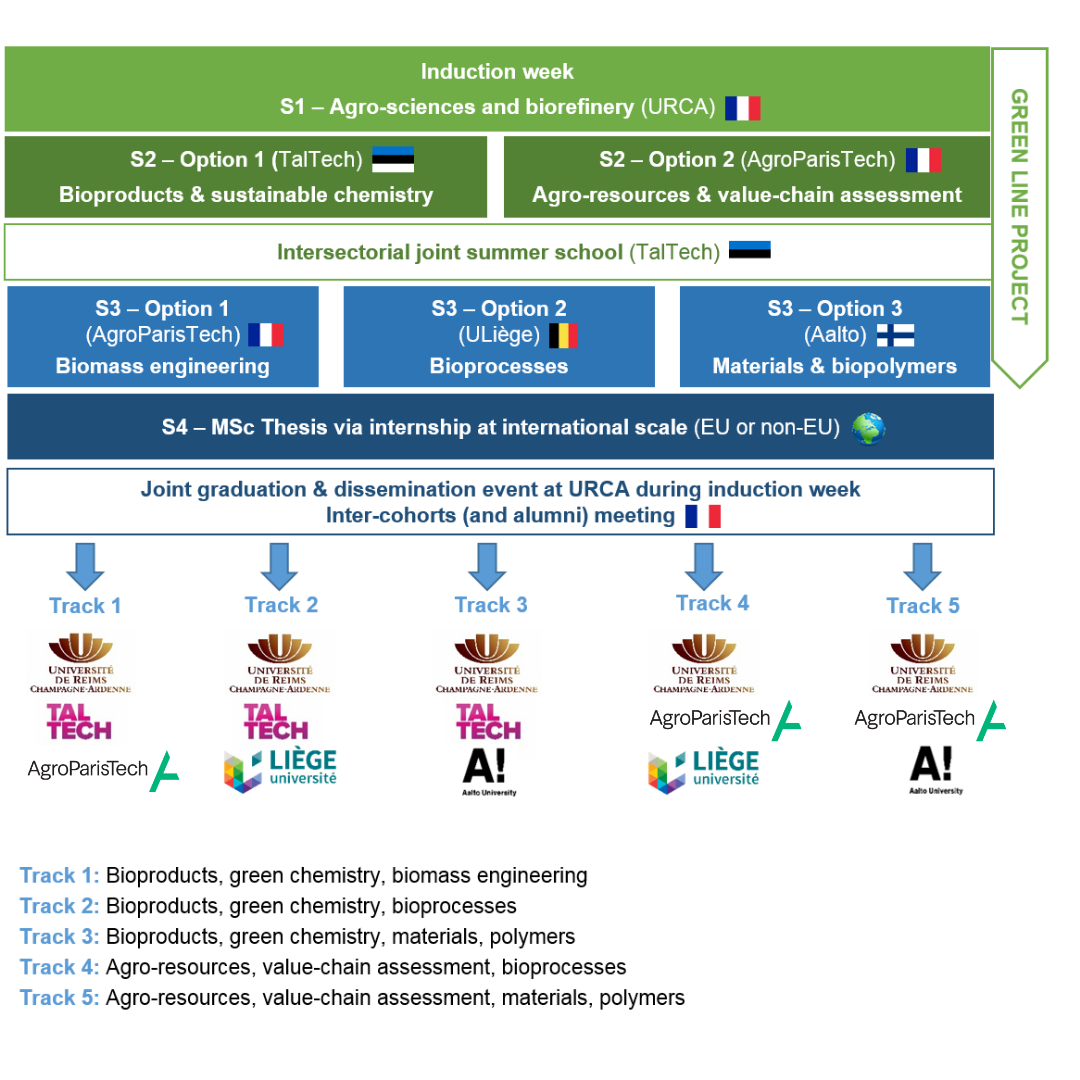
- S1 takes place at URCA (France)
- according to the choice of study track, S2 takes place either at AgroParisTech (France) or TalTech (Estonia). A mandatory summer school will take place in Estonia at the end of S2, ensuring that all students have a learning experience in Estonia
- for students who spent the S2 in Estonia, S3 can take place at AgroParisTech (France), Aalto (Finland) or ULiège (Belgium), according to the chosen specialisations and students’ professional plans
- for students who spent their S2 in France, S3 can either be in Aalto (Finland) or ULiège (Belgium)
- there is no restriction for S4 Master’s thesis/internship location.
Choice of the study track
During their application to Bioceb, students are required to indicate 2 study tracks on the application platform, ranked in order of preference. This choice must be clearly justified in relation to their academic background and professional goals. Candidates invited for an interview are also expected to explain and defend their study tracks’ selection. The final decision is made by the evaluation committee, taking into account both the relevance of the applicants’ choices and the number of available places in each track, which are limited for logistical and human resource reasons. As a result, the first choice cannot always be guaranteed. Students are informed of their final allocation by email and in their admission letter.
Updated June 2026