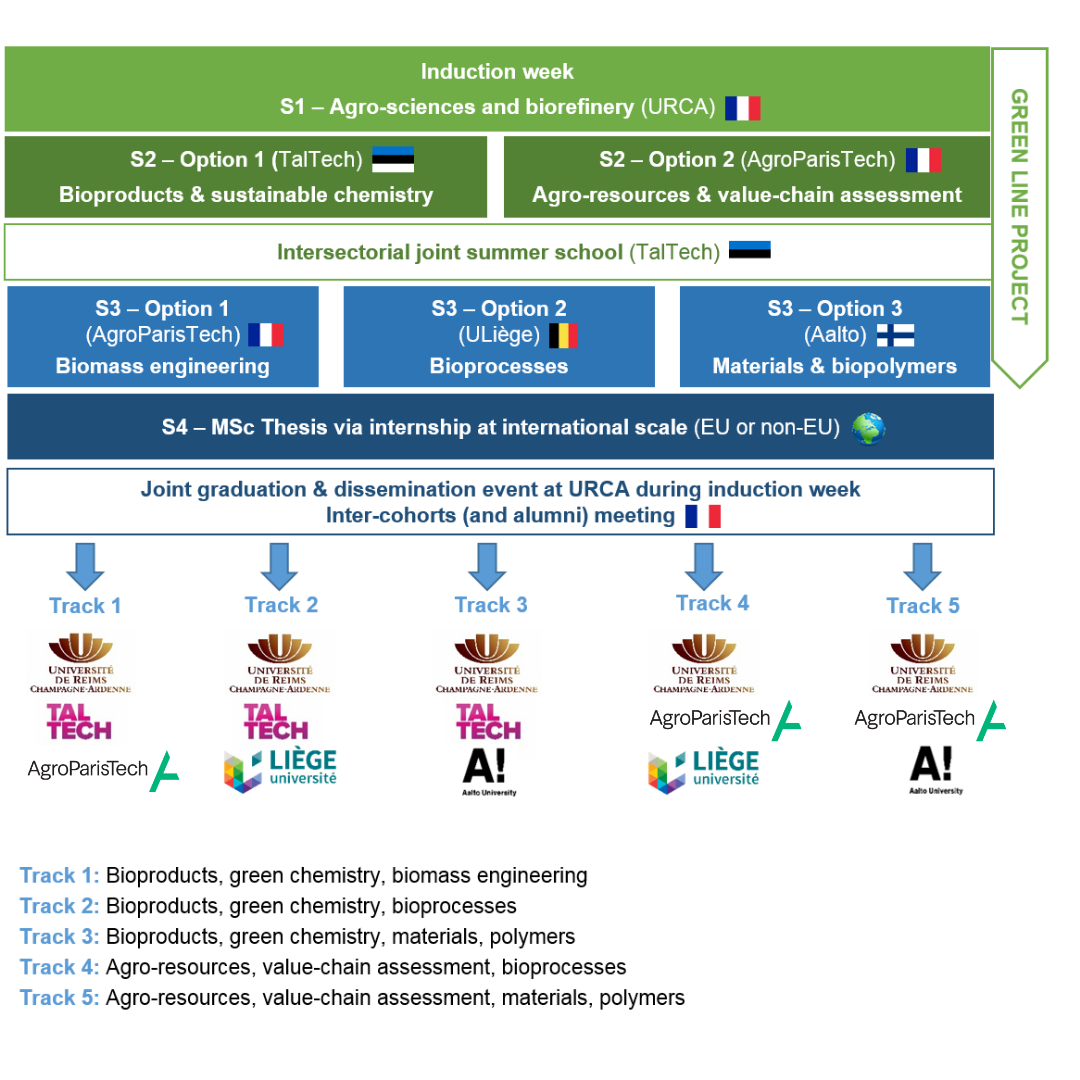
Bioceb offers students a fully integrated Master’s programme recognised in all participating countries. Its modular organisation favours student mobility and international experience, while preserving "jointness" and interconnection between the different possible tracks.
General organisation and content of the semesters
The joint first semester (S1) at URCA provides a multidisciplinary scientific knowledge base and a shared culture in the field of agro-resources and their conversion through biorefinery processes.
The second semester (S2) allows the students to enrich their technical and scientific experience with cross-cutting approaches dealing with value-chain sustainability assessment, with a specific focus either on economics (AgroParisTech) or on green chemistry principles (TalTech).
The third semester (S3) offers a specialisation in one of the key biotechnology approaches of bioeconomy: biomass engineering (AgroParisTech), bioprocesses (ULiège) and bio-based products (Aalto).
The fourth semester (S4) is dedicated to an R&D internship, according to your specialisation path and professional plans, leading to a master’s thesis preparation and defence.
Tailored study tracks adapted to specific profiles needs
The modular organisation of Bioceb combines joint training ("jointness") with flexible curricula tailored to students’ professional goals and to current and future labour market needs. The study tracks have been designed to respond to sector demands thanks to educational offers from all Bioceb partners. The graduates present diverse profiles and a global understanding of the bioeconomy. They are equipped to contribute to the development of the bio-based sector as scientists, innovators, managers, or entrepreneurs. This approach ensures coherent and employable profiles while maintaining academic consistency and a joint learning experience.
| Track | Targeted scientific and management activities |
| Track 1: Bioproducts, green chemistry, biomass engineering | Production of tailored plants and microorganisms to increase the sustainability of the value chains (adaptation of plants to climate change, preservation of biodiversity and food resources, etc.) |
| Track 2: Bioproducts, green chemistry, bioprocesses | Design, optimisation and up-scaling of processes for the production of bio-based molecules, combining fermentation and chemistry and taking into account the principle of green chemistry (in particular waste reduction) |
| Track 3: Bioproducts, green chemistry, materials, polymers | Design and development of bioproducts and biomaterials in particular biodegradable materials, and exploiting the diversity of new structures |
| Track 4: Agro-resources, value chain assessment, bioprocesses | Design of new sustainable value chains and processes involving flexible multiresources and multi-products biorefineries |
| Track 5: Agro-resources, value chain assessment, materials, polymers | Design of new sustainable value chains and products for bio-based materials, to substitute fossil-based solutions and create new products |
Learning outcomes
At the end of Bioceb, all students will have acquired the following competencies:
- Double chemistry-biology competences including knowledge of the principles of green chemistry and associated metrics, plant science with awareness of biodiversity, and disciplinary knowledge in biochemistry, molecular biology, and microbiology
- Skills in process and materials engineering applied to biomass production and conversion into bio-based products and energy
- Capacity to implement integrated multi-disciplinary approaches in order to design new sustainable routes for the valorisation of agro-resources or industrial waste
- Skills in carrying out experiments in a scientific research approach for bioeconomy-related projects
- Knowledge of sustainable and cleaner production routes
- Life Cycle Analysis (LCA)
- Applying green chemistry metrics leading to sustainable manufacturing in line with circular economy objectives
- Awareness of the global diversity of bioeconomy models and biorefinery systems (biomass, transformation strategies and end-products markets) and their relationships with territories
- Understanding of the techno-economic and legal constraints associated with the development of bio-based products and bioprocesses
- Skills in project engineering with knowledge of innovation processes and of the different stages leading to industrialisation from the laboratory research step (technological readiness levels)
- Soft skills: ability to discuss with people from different cultural backgrounds and take into account social and ethical expectations, to interact within a group and exploit the diversity of skills to build up and carry out a project, to communicate and disseminate scientific results, to take risks and address challenges
Funded by the European Union. Views and opinions expressed are however those of the author(s) only and do not necessarily reflect those of the European Union or the European Education and Culture Executive Agency (EACEA). Neither the European Union nor EACEA can be held responsible for them.
Updated June 2026