National Institute of Technology for Life, Food and Environmental Sciences (AgroParisTech) / Paris-Saclay University (UPSaclay), France
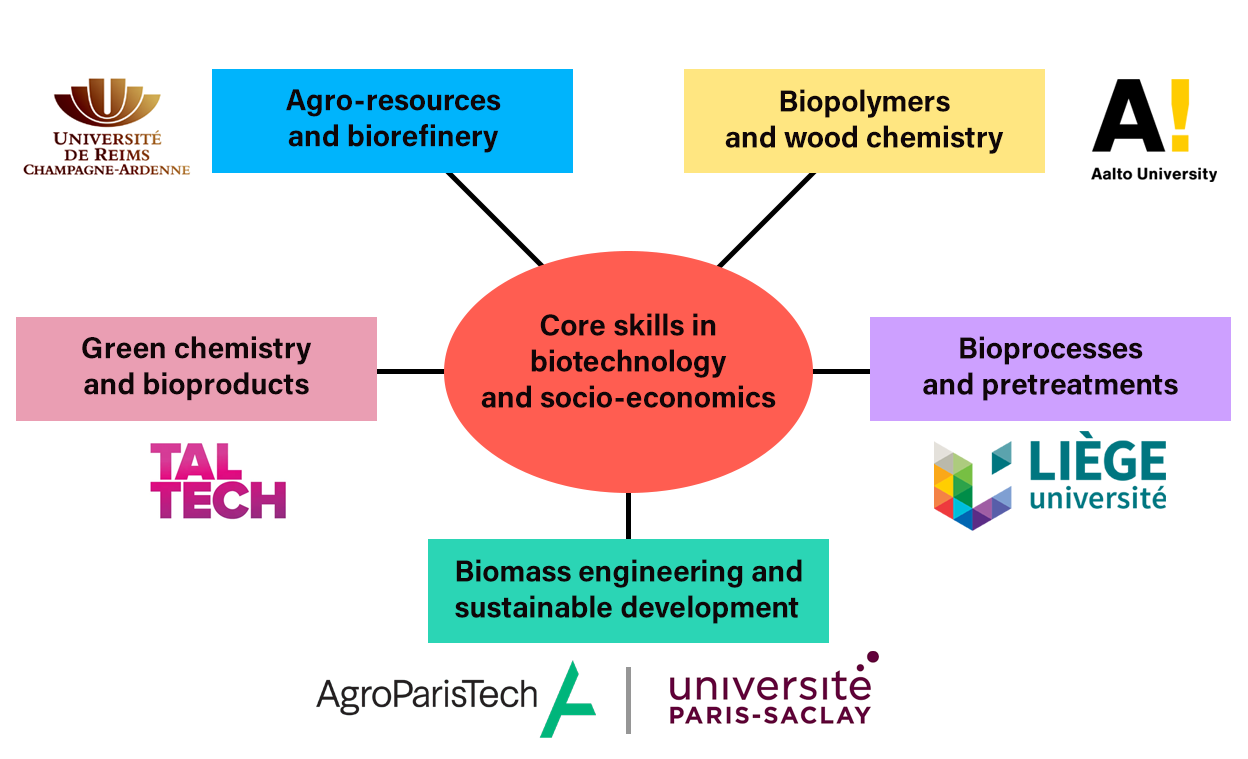
AgroParisTech is an institute created in 2007 with an history of about 200 years. As a major actor in higher education and research, AgroParisTech’s forward-looking approach is aimed at addressing the main global challenges of the 21st century: fostering knowledge and understanding to enable humanity to better safeguard our ecosystems, feeding populations while preserving natural resources, and sustainably managing the environment. Its 5 Education & Research Departments conduct a fully encompassing approach of bioeconomy. It trains engineers, executives, PhDs and managers in the field of life sciences and environment through exposure to the field and research, as well as close links with the professional world. It is also a founding member and a component institution of UPSaclay, a leading university in Europe and the world, which covers the fields of science and engineering, life sciences and health, and humanities and social sciences. UPSaclay science policy closely intertwines research and innovation, incorporating both basic and applied science to tackle major societal challenges.
Aalto University, Finland
Aalto is a multidisciplinary community of bold thinkers, where science and art meet technology and business. The University is committed to identifying and solving grand societal challenges and building an innovative future. The institution is a foundation-based university. Courses are offered across the schools of arts, design and architecture, business, chemical engineering, electrical engineering, engineering and science.
University of Liège (ULiège) / Gembloux Agro-Bio Tech, Belgium
ULiège is a public university of general interest which is dependent on the Wallonia-Brussels Federation and, with a view to excellence and quality, carries out the following 3 complementary missions:
– Taking part in individual or collective research, innovation or creative activities;
– Offering education and initial and continuing higher education courses and certifying the knowledge and skills acquired;
– Providing services to the community, thanks to their specialised expertise and their duty to be independent, attentive to the needs of society.
Gembloux Agro-Bio Tech, a faculty of the University of Liège, is exclusively dedicated to life sciences and bioengineering. It is a faculty on a human scale, located in the centre of Belgium, with state-of-the-art facilities that make it a veritable open-air laboratory for its students and researchers. The faculty trains academics and engineers capable of meeting the expectations of a rapidly changing society in the fields of environmental protection, agronomic production, and the processing and valorisation of bioresources.
University of Reims Champagne-Ardenne (URCA), France
URCA is a multidisciplinary training and research university positioned and recognised nationally and internationally in the bioeconomy field. This academic identity at the heart of an interdisciplinary approach is based on 4 strategic excellence clusters and the specifics of its ecosystem. Rooted in its region (5 university towns - 13 campuses) but with an international outlook, URCA contributes to the dynamism, attractiveness, international competitiveness and the development of higher education and research at a national and European level.
Tallinn University of Technology (TalTech), Estonia
TalTech is the only flagship in engineering and IT science and education in Estonia, providing higher education at all levels in engineering and technology, information technology, economics, science, and maritime. TalTech is a forerunner in digitalisation and cyber security. Its mission is to be a promoter of science, technology, and innovation and a leading provider of engineering and economic education in Estonia. It is the most innovative and international university in Estonia. It comprises 4 Schools and the Estonian Maritime Academy, and 20 Departments.
Updated April 2026